Daxxify. The longer-lasting neurotoxin.
Daxxify (daxibotulinumtoxinA) — peptide-stabilized, six-to-nine-month duration in trials, and who benefits from the longer interval.
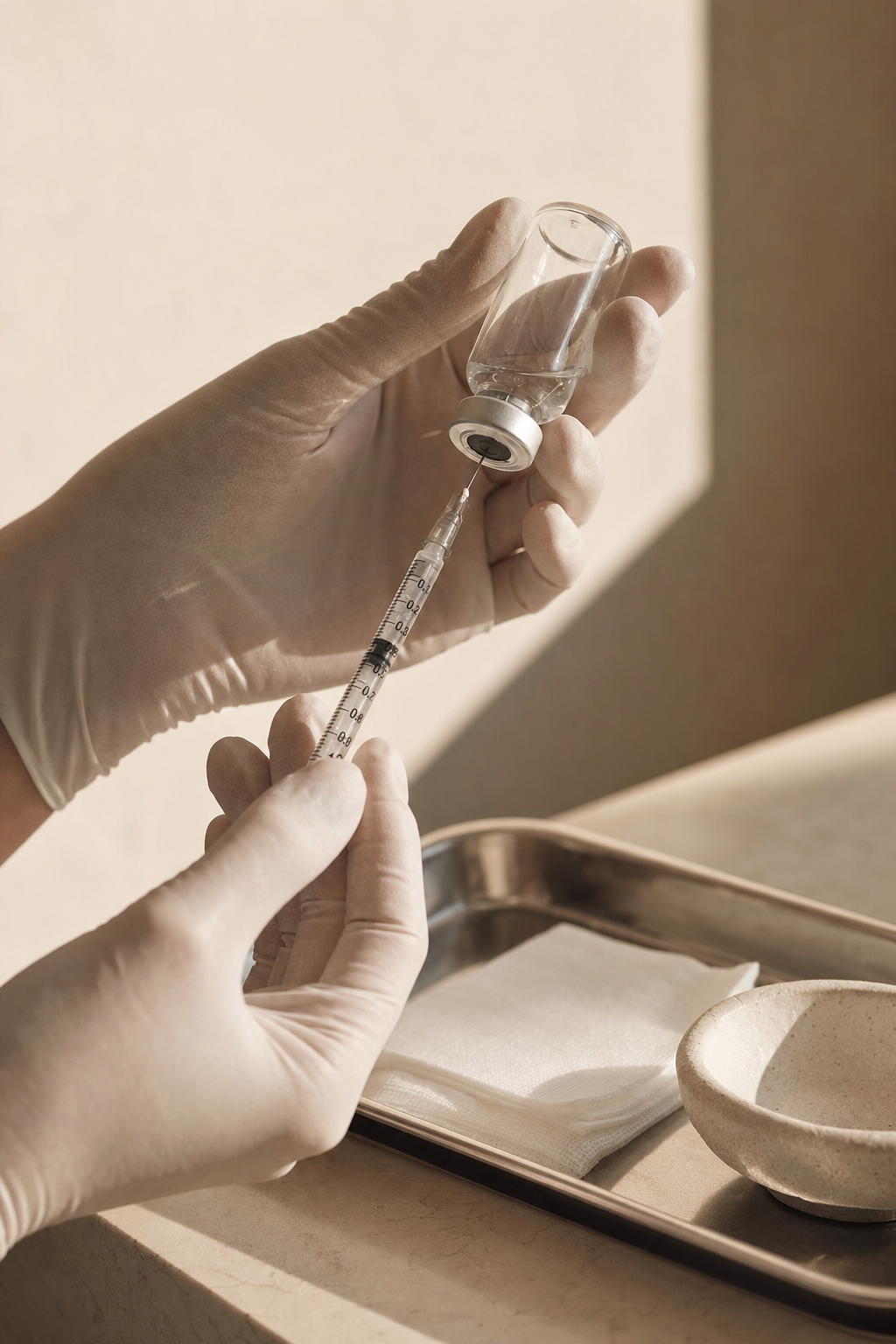
Daxxify is daxibotulinumtoxinA — Revance's peptide-stabilized botulinum toxin type A, working by the same mechanism as Botox. Its formulation swaps the human-derived stabilizing protein other products use for a synthetic peptide, and its headline claim is duration: 6–9 months in clinical trials, against 3–4 months for conventional neurotoxins.
The peptide, and what it changes.
Most neurotoxins are stabilized with human serum albumin, a blood-derived protein. Daxxify replaces it with a small synthetic peptide that binds the active molecule and — per the manufacturer's account — helps it stay where it's placed and persist longer at the nerve ending. It's the first neurotoxin formulated without human- or animal-derived components.
The duration data comes from the product's pivotal trials, where the median time before patients returned to baseline ran roughly six months, with a meaningful share holding effect toward nine. The honest framing: those are trial figures. In day-to-day practice we see many Daxxify patients comfortably reach five to six months — clearly longer than conventional products, if not always the trial ceiling. Onset can run slightly slower than Botox for some patients, and the wear-off, when it comes, is just as gradual.
Who actually benefits from a longer interval.
Patients on conventional neurotoxins visit three to four times a year. Daxxify's pitch is two. That matters most for people whose calendar is the constraint: frequent travelers, patients who book months out, anyone who keeps arriving at appointments having fully worn off — which means starting over rather than maintaining.
It's not for everyone. First-time patients are usually better served by a shorter-acting product for the opening round: if the dose or placement needs adjusting, you want that lesson to last four months, not nine. Patients who like to fine-tune season by season feel the same way. We'll often run a conventional product first and graduate a patient to Daxxify once the pattern is dialed in.
Think in cost per year, not cost per visit.
Per treatment, Daxxify carries a premium — at Los Angeles market rates an upper-face treatment typically runs $550 – $850, against $400 – $700 for the same areas with a conventional product. Looked at per visit, that reads as the expensive option.
Per year, the math tightens. Two Daxxify treatments versus three or four conventional ones lands the annual figure in a comparable band, and sometimes under it — before counting the appointments you didn't have to book. Whether the premium is worth it is mostly a question about your tolerance for visits, not your budget. Exact totals are discussed at consultation, in writing, like everything else we price.
It's newer. That counts in both directions.
Daxxify earned FDA approval in 2022. Its trial program was large and its safety profile so far looks consistent with the category — but Botox has decades of accumulated use behind it, and there's no pretending those track records are equivalent yet. Some patients reasonably prefer the product with the longest history; some prefer Dysport's fast onset or Xeomin's stripped-down formulation. All are sound choices.
Our role isn't to sell the newest thing. It's to lay out the four products we stock — what each does well, what it costs over a year, what we'd choose in your position — and let the decision be yours. That conversation is what the consultation is for.
Performed by Orr Swissa-Amran, PA-C, board-certified Physician Associate, internationally trained in hair restoration and aesthetic medicine.
Questions we get.
Daxxify vs Botox — what's the real difference?
Same mechanism, same kinds of results; the difference is duration and formulation. Daxxify is stabilized with a synthetic peptide rather than human serum albumin, and ran 6–9 months in trials against Botox's typical 3–4. Botox counters with decades of track record and a slightly faster onset for some patients.
Is Daxxify more expensive?
Per treatment, yes — typically $550 – $850 for the upper face at Los Angeles market rates, a premium over conventional products. Per year, two Daxxify visits versus three or four conventional ones usually lands in a comparable range. We walk through both numbers at consultation.
How long does Daxxify last?
In clinical trials, a median of roughly six months, with some patients holding effect toward nine. In practice, many of our Daxxify patients comfortably reach five to six months — meaningfully longer than conventional neurotoxins, though individual response varies.
Is Daxxify safe?
It's FDA-approved, with a large trial program and a safety profile consistent with the neurotoxin category — the same contraindications apply: pregnancy, breastfeeding, and certain neuromuscular conditions. It is newer than Botox, and we say that plainly; patients who want the longest track record have a reasonable case for staying conventional.
Continue.
Four FDA-approved botulinum toxin products — what differentiates them, how we dose, where we treat, and the cadence that actually holds.
Dysport (abobotulinumtoxinA) — how it differs from Botox, where its wider diffusion helps, unit conversion, and onset timing.
Xeomin (incobotulinumtoxinA) — the uncomplexed neurotoxin, why that matters for antibody resistance, and how it doses against Botox.
Botox in Calabasas at Swissa Med Spa — mechanism, treatment areas, dosing approach, and what a first appointment looks like at our studio.
Schedule a consultation for daxxify. the longer-lasting neurotoxin.
“Nicole has been doing my botox for a while now, and honestly, I wouldn't trust anyone else with my face!”