Glutathione injections.
Glutathione injections — the master antioxidant, what injection delivers that oral doesn't, skin-brightening evidence honestly framed.
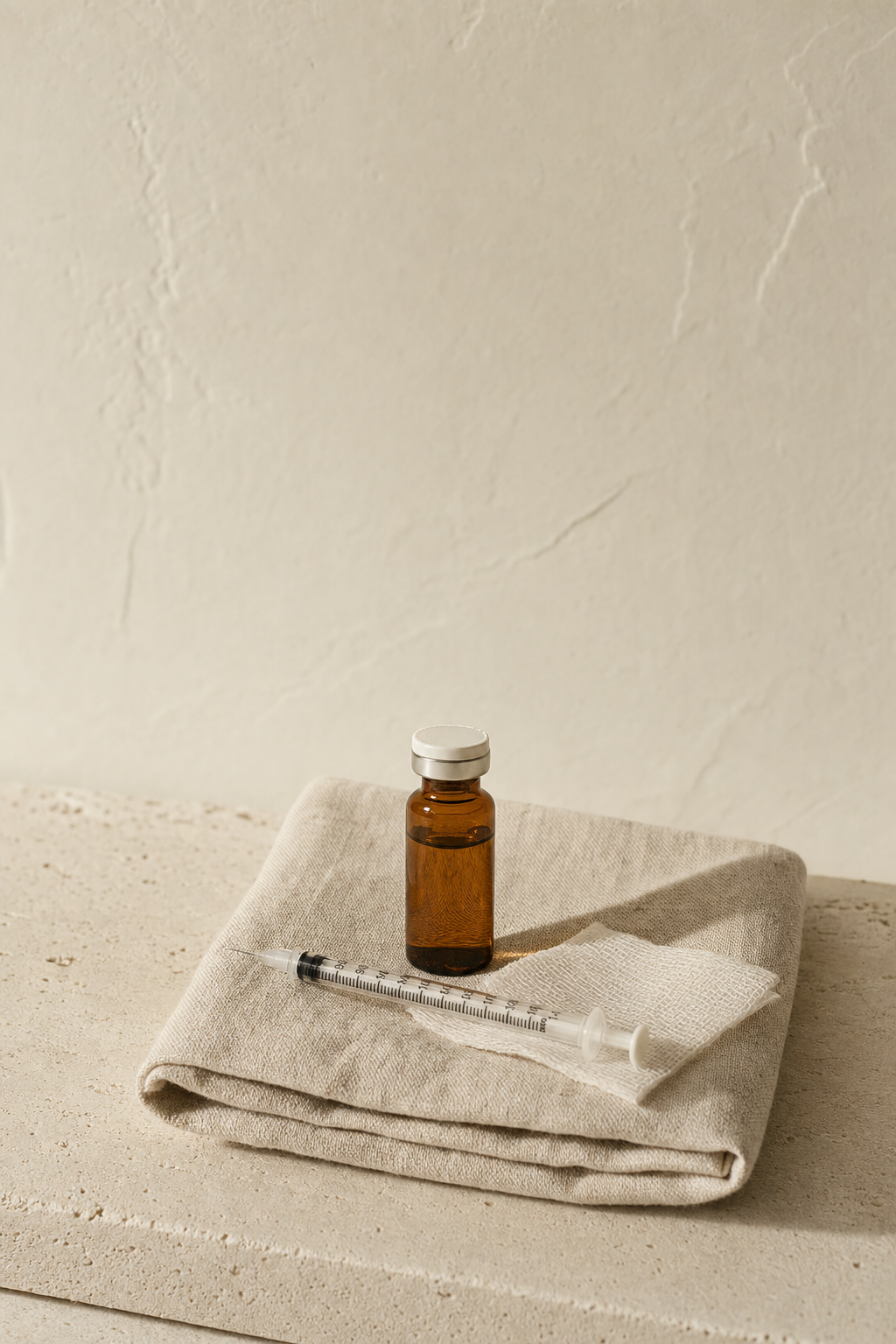
Glutathione injections deliver the body's master antioxidant directly into muscle — a tripeptide of glutamine, cysteine, and glycine made in nearly every cell, central to neutralizing oxidative stress and supporting the liver's detoxification pathways. Injection exists because oral glutathione is largely broken down in digestion before it reaches the bloodstream. We administer it for specific indications, with honest framing — including the candid caveat that the skin-brightening evidence is mixed.
The body's master antioxidant.
Glutathione earns the 'master antioxidant' label honestly: it's the most abundant antioxidant the body makes, present in nearly every cell, where it neutralizes reactive oxygen species, recycles other antioxidants like vitamins C and E, and serves as the workhorse of the liver's phase-two detoxification pathways. The body synthesizes it from three amino acids — glutamine, cysteine, and glycine.
Levels aren't fixed. Tissue glutathione declines with age and runs lower under sustained oxidative load — chronic illness, certain medications, heavy alcohol use, poor sleep. That decline is real and measurable; what restoring it accomplishes clinically is a more careful conversation, and we have it plainly at consultation.
The honest summary: glutathione is genuinely important physiology, the supplementation case is real in specific contexts, and the wellness market has run well ahead of the evidence in others. This page separates the two.
The oral problem injection solves.
Swallowed glutathione has a bioavailability problem: digestive enzymes break the tripeptide apart before much of it reaches circulation intact. Studies of standard oral glutathione show modest-at-best changes in blood levels. Injection — intramuscular, or intravenous as part of a protocol — bypasses digestion entirely and delivers the intact molecule.
That's the case for the route, not automatically the case for the therapy. Oral strategies exist that work around the absorption problem — N-acetylcysteine, a precursor the body converts to glutathione, has reasonable evidence behind it and costs far less. For some patients the precursor route is the right answer, and we say so when it is.
Where injection earns its place is when the indication calls for reliably raising circulating glutathione — and when a screened patient, knowing the oral alternatives, prefers the directness of the injectable route on a defined, re-assessed course.
Where glutathione fits, honestly framed.
The evidence base varies meaningfully by indication. We name the strength of the case alongside the use rather than letting the menu imply more than the data supports.
| Oxidative stress supportThe most defensible use | For patients with documented oxidative stress markers or contexts that deplete glutathione — certain chronic conditions, medication loads, recovery phases. Supportive therapy alongside care, not a treatment for any disease. |
|---|---|
| Skin brighteningEvidence mixed · largely cosmetic-grade | The most-asked-about use and the least settled. Some small studies report modest, temporary lightening with sustained dosing; the effect reverses when injections stop, and the better trials are short, small, and mostly oral or topical. We'll administer it for patients who understand exactly that framing — we won't sell it as a reliable result. |
| Post-weight-loss skin supportAdjunct · often paired with B12 | Patients finishing rapid weight reduction on GLP-1 therapy sometimes add glutathione for skin quality alongside B12 for nutritional support — reduced food intake during the program can leave both worth addressing. A reasonable adjunct with expectations set honestly. |
| Liver supportAdjunct only | Glutathione is central to hepatic detoxification, and supportive use has a mechanistic rationale in patients with oxidative liver stress. It is not a treatment for liver disease — patients with actual hepatic pathology need a hepatologist, and we coordinate rather than substitute. |
Often weekly, course-based, re-assessed.
- 01
Intake first.
Medical history, current medications, and what you're hoping to address. Labs where the indication calls for them. Glutathione is well tolerated, but we screen rather than assume.
- 02
A defined course.
Typical protocols run weekly injections for six to eight weeks. Skin-related goals, where patients pursue them, generally require the sustained end of that range — single sessions don't produce visible change.
- 03
Re-assessment.
At the end of the course we ask the plain question: did anything change? Patients with a meaningful response can move to a maintenance cadence; patients without one stop, rather than buying indefinite rounds.
- 04
Maintenance, if earned.
Every two to four weeks for patients continuing. Effects that depend on circulating glutathione fade after discontinuation, and we're upfront that maintenance means ongoing visits.
- Permanently change skin tone — any lightening effect is gradual, modest, and reverses after injections stop.
- Replace sunscreen, retinoids, or laser-based treatment for pigmentation — those remain the evidence-backed tools.
- Detoxify a healthy body beyond what your liver already does daily.
- Treat fatigue without an identified cause — energy complaints get screened, not injected.
- Substitute for medical care of liver disease or any diagnosed condition.
Supervised by Dr. Charles Peterson, board-certified physician with nearly a decade in aesthetic medicine.
Questions we get.
What are the benefits of glutathione injections?
Reliably raised circulating glutathione — useful where oxidative stress support is the goal, since oral glutathione absorbs poorly. Patients report skin-quality and general-wellness benefits that are harder to verify; the controlled evidence is strongest for the antioxidant biochemistry and weakest for cosmetic claims. We frame each use accordingly.
How many sessions before I notice anything?
Courses run weekly for six to eight weeks before we judge response. Skin-tone changes, when they occur at all, are gradual and appear toward the end of a sustained course — and fade after stopping. A single injection is a dose, not a result, and we won't pretend otherwise.
What are the side effects?
Few, typically. Brief injection-site soreness is the most common; some patients notice a transient sulfur-like taste or smell. Allergic reactions are rare but possible, as with any injectable. High-dose IV protocols occasionally produce cramping or nausea during infusion — slowing the rate resolves it.
How much do glutathione injections cost?
In Los Angeles, single glutathione IM injections typically run $40 – $50; IV protocols that include glutathione run $150 – $400 per session. A weekly course therefore lands roughly $160 – $200 per month at market rates. Our pricing is discussed at consultation.
Continue.

Injectable-vs-oral rationale, candidacy, frequency, what we won't inject. No miracle claims.

Methylcobalamin vs cyanocobalamin, candidacy, dosing frequency.

GLP-1 mechanism, on-label vs off-label use, candidacy, side-effect management, what happens when you stop.
Schedule a consultation for glutathione injections.
“They're truly my one-stop shop for everything beauty and skincare. The entire team is so knowledgeable, honest, and always ready to help…”