SkinPen microneedling. The FDA-cleared device.
SkinPen — the FDA-cleared microneedling device we run. Depth control, single-use cartridges, the 3-session cadence, and the add-on stack.
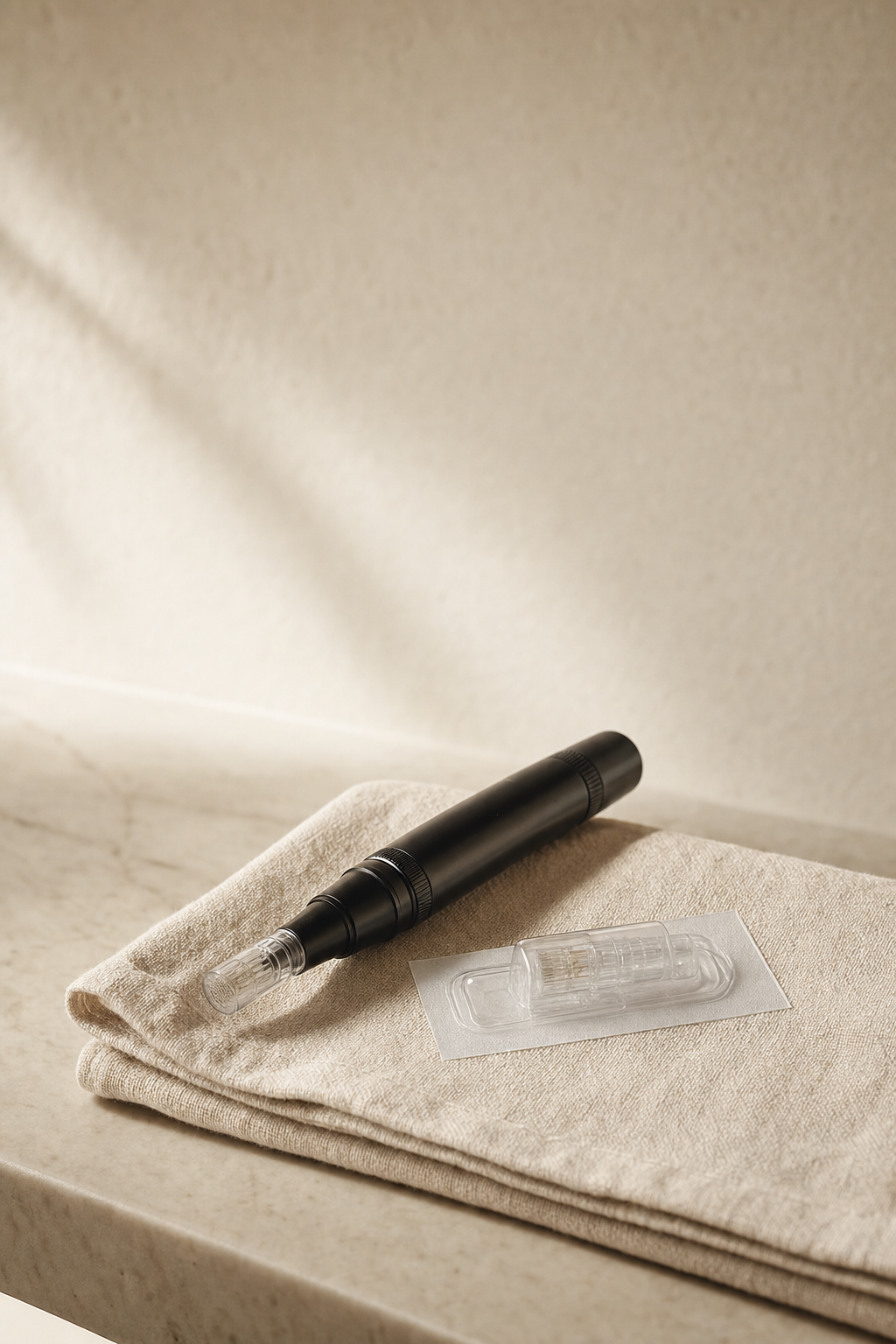
SkinPen Precision is the microneedling device our regenerative work runs on — the first microneedling device cleared by the FDA, with adjustable depth and a sterile, single-use needle cartridge for every patient. It creates thousands of controlled micro-channels in the skin; the body closes them by building new collagen. Most plans run three sessions, four to six weeks apart, with optional biological add-ons applied while the channels are open.
What FDA clearance buys you.
Microneedling pens are not interchangeable. SkinPen was the first microneedling device to receive FDA clearance — initially for facial acne scars in adults twenty-two and older, later extended to neck wrinkles. Clearance means the manufacturer put the device through a formal review of safety and performance data, and the production line is held to a quality system the FDA can audit. Unbranded pens sold online carry none of that.
The engineering differences are concrete. Needle depth adjusts in fine increments from 0.25 mm to roughly 2.5 mm, so the same session can run shallow over the lower eyelid and deeper across acne scarring on the cheek. The needle cartridge — fourteen sterile micro-needles — is opened in front of you and discarded after your session. A lockout prevents cartridge reuse, and an internal seal keeps fluid from being drawn back into the pen body between patients. Cross-contamination is the quiet risk in this category; the cartridge design is the answer to it.
None of this makes needling exotic — the mechanism is the same controlled wound either way. It makes the floor higher: known depth, known sterility, a device with a paper trail. For a treatment whose entire premise is thousands of deliberate punctures, the paper trail is the point.
Collagen induction, in plain terms.
Each pass of the SkinPen creates micro-channels through the epidermis into the upper dermis. The skin reads these as injuries and runs its standard wound-healing program: a day or two of inflammation, then proliferation — fibroblasts producing new collagen and elastin — then weeks of remodeling, in which the new collagen organizes and the skin's texture visibly changes.
Because the channels are narrow and the surface between them stays intact, healing is fast. That's what separates microneedling from ablative resurfacing, which removes the surface to provoke a similar remodeling response. The trade is gentler change per session in exchange for 24 – 72 hours of downtime instead of two weeks.
The channels also leave the skin briefly permeable — for roughly an hour, a topical applied to the treated area reaches the dermis rather than sitting on the surface. That window is why the add-on menu below exists.
Three sessions, then judgment.
Collagen remodeling is cumulative, so SkinPen is planned as a series rather than a single visit.
- 01
Consultation and first session.
We assess the indication — texture, fine lines, post-acne scarring — set depth by zone, and decide whether an add-on earns its cost for your case. Topical numbing, then the pass; about an hour in the room.
- 02
Four to six weeks between visits.
Each interval gives the wound-healing cascade time to complete before it's triggered again. Booking closer together doesn't accelerate results; it interrupts them.
- 03
Sessions two and three.
Same protocol, depth adjusted to how the skin responded. Visible change usually registers between the second and third sessions — earlier for tone, later for scarring.
- 04
Reassess at twelve weeks.
New collagen matures for roughly three months after the final session. We photograph and compare at that mark, then decide between maintenance — one or two sessions a year — and a fourth session for heavier indications.
What can ride in the channels.
Each add-on has its own page with the mechanism, evidence, and cost detail — linked below this article. The one-sentence versions:
| PRPThe Vampire Facial · autologous | Your own platelets, drawn and spun the day of treatment — the most established add-on, with decades of use across medicine before aesthetics adopted it. |
|---|---|
| ExosomesLab-derived signaling vesicles | Extracellular vesicles carrying growth-factor cargo into the open channels — the newest entry on the menu, with an evidence base that is promising but younger than PRP's. |
| PolynucleotidesPDRN · salmon-DNA fragments | Purified salmon-DNA fragments with a long clinical track record in Korea and Europe for tissue regeneration, atrophic scarring, and skin quality in thin-skinned areas. |
| GHK-CuCopper peptide | A copper tripeptide with documented wound-healing and collagen-supporting effects, usually layered alongside another add-on rather than run alone — covered on the polynucleotides page. |
Performed by Orr Swissa-Amran, PA-C, board-certified Physician Associate, internationally trained in hair restoration and aesthetic medicine.
Questions we get.
How much does SkinPen cost per session?
Plain SkinPen in the Los Angeles market typically runs $300 – $500 per session; adding a biological active moves a session to $600 – $1,500 depending on the add-on. Our pricing is set at consultation, with the series and per-session math in writing before you book.
What are the side effects?
Expected: redness, mild swelling, tightness, temporary dryness. Uncommon: pinpoint bruising, a short-lived breakout, or cold-sore reactivation in patients with a history — we premedicate for that. The single-use cartridge and the cleared device exist to keep the rare risks, infection and scarring from over-aggressive depth, rare.
Is SkinPen better than a dermaroller or an at-home pen?
Different category. At-home rollers work at depths too shallow to remodel collagen, and reused needles are a contamination risk. An in-office SkinPen session reaches the dermis at a controlled depth with a sterile cartridge opened for you. The honest framing: at-home tools are skincare; this is a procedure.
What is the downtime?
24 – 72 hours of redness, similar to a mild sunburn, occasionally with pinpoint flaking on day two or three. Most patients work the next day. We'd avoid booking the day before an event you'll be photographed at.
Am I a candidate if I have a darker skin tone?
Usually, yes. Microneedling carries a meaningfully lower pigment risk than many lasers because there's no heat targeting melanin, and it's commonly used across Fitzpatrick types IV – VI. We still adjust depth and aftercare by skin tone and screen for keloid history — candidacy is confirmed in person.
Continue.

Microneedling layered with growth factors, exosomes, PDRN or copper peptide. What each add-on does, what it costs you in downtime.
Microneedling with exosomes — extracellular vesicles applied into SkinPen channels. What the evidence shows, how it compares with PRP.
PDRN polynucleotides and GHK-Cu copper peptide as SkinPen add-ons — salmon-DNA-derived tissue regeneration, where each fits, evidence base.

Blood-derived growth factors microneedled into skin. What it is, what it isn't, and how it differs from the broader regenerative menu.
Schedule a consultation for skinpen microneedling. the fda-cleared device.
“They're truly my one-stop shop for everything beauty and skincare. The entire team is so knowledgeable, honest, and always ready to help…”