Eyebrow hair transplant vs microblading. Which is right for you?
Microblading is a pigment tattoo: a paramedical tattooer draws hair-stroke pigment into the dermis. It's a candidate-friendly procedure with a one- to three-year lifespan. An eyebrow hair transplant is a surgical FUE procedure: real follicles are harvested from the scalp and implanted into the brow. It's permanent, narrower in candidacy, and an order of magnitude more invasive. The right answer depends on your brow situation, your tolerance for downtime, and how permanent a result you actually want.
Side by side, plainly.
Two different categories — surgical follicle restoration versus paramedical tattooing. The table is the fast version. Detail underneath.
| Microblading (Ruth Swissa) | Eyebrow hair transplant (Swissa Med Spa) | |
|---|---|---|
| What it is | A paramedical tattoo. Pigment placed in the dermis with a hand tool, in hair-stroke pattern. | An FUE surgical procedure. Real hair follicles harvested from the scalp and implanted into the brow. |
| Permanence | Semi-permanent. 1 – 3 years before fade. Touch-ups extend it. | Permanent. The follicles grow on their own schedule, like scalp hair. |
| Candidacy | Nearly every patient. Skin tone and existing hair adjusted for in technique. | Narrower. Donor density, scalp health, target shape, and certain medications all matter. |
| Investment | $600 at Ruth Swissa, including the 6-week touch-up. | $4,000 – $8,000+ depending on graft count. |
| Downtime | 24 hours. Some patients return to work the same day. | 7 – 14 days of visible scabbing and pinkness at the recipient site. |
| Trimming / styling | None — the pigment is the brow. | Yes — transplanted scalp hair grows continuously and needs trimming. |
| Reversibility | Fades naturally. Can be tattoo-removed if needed. | Surgical. Not reversible. |
| Where we do it | Ruth Swissa paramedical studio. | Swissa Med Spa, with a credentialed surgeon partner. |
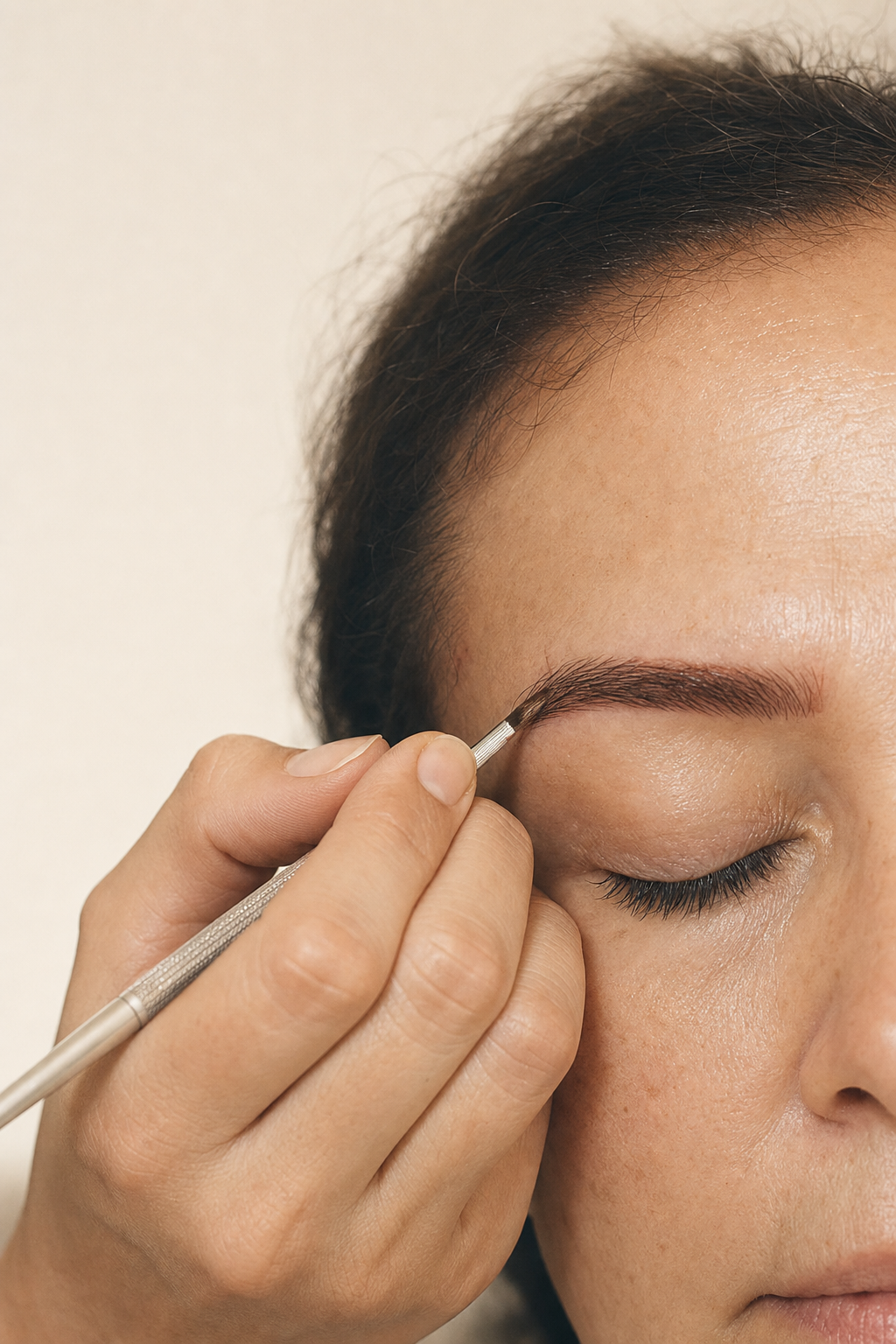
What microblading actually does.
Microblading is a paramedical tattoo using a manual hand tool with a configuration of tiny needles. Pigment is implanted into the upper dermis as fine, individual strokes that mimic real hair. Done well, it reads as natural brow hair from conversational distance — and even up close, the pattern, color, and stroke direction look intentional rather than drawn-on.
It is — and this is the point — a tattoo. The pigment is in the skin. It will fade over twelve to thirty-six months as the body's lymphatic system carries pigment particles away. Touch-ups every twelve to eighteen months keep the result fresh; without touch-ups, the brow slowly retreats to its pre-procedure baseline. There is no shock-loss phase, no scarring at a donor site, and no possibility of grafts that don't take. Every patient who is a candidate gets a result on the first session.
It is also — and this matters for the cost comparison — a fraction of the investment of a transplant. At Ruth Swissa, the full procedure including the 6-week perfecting session is $600.
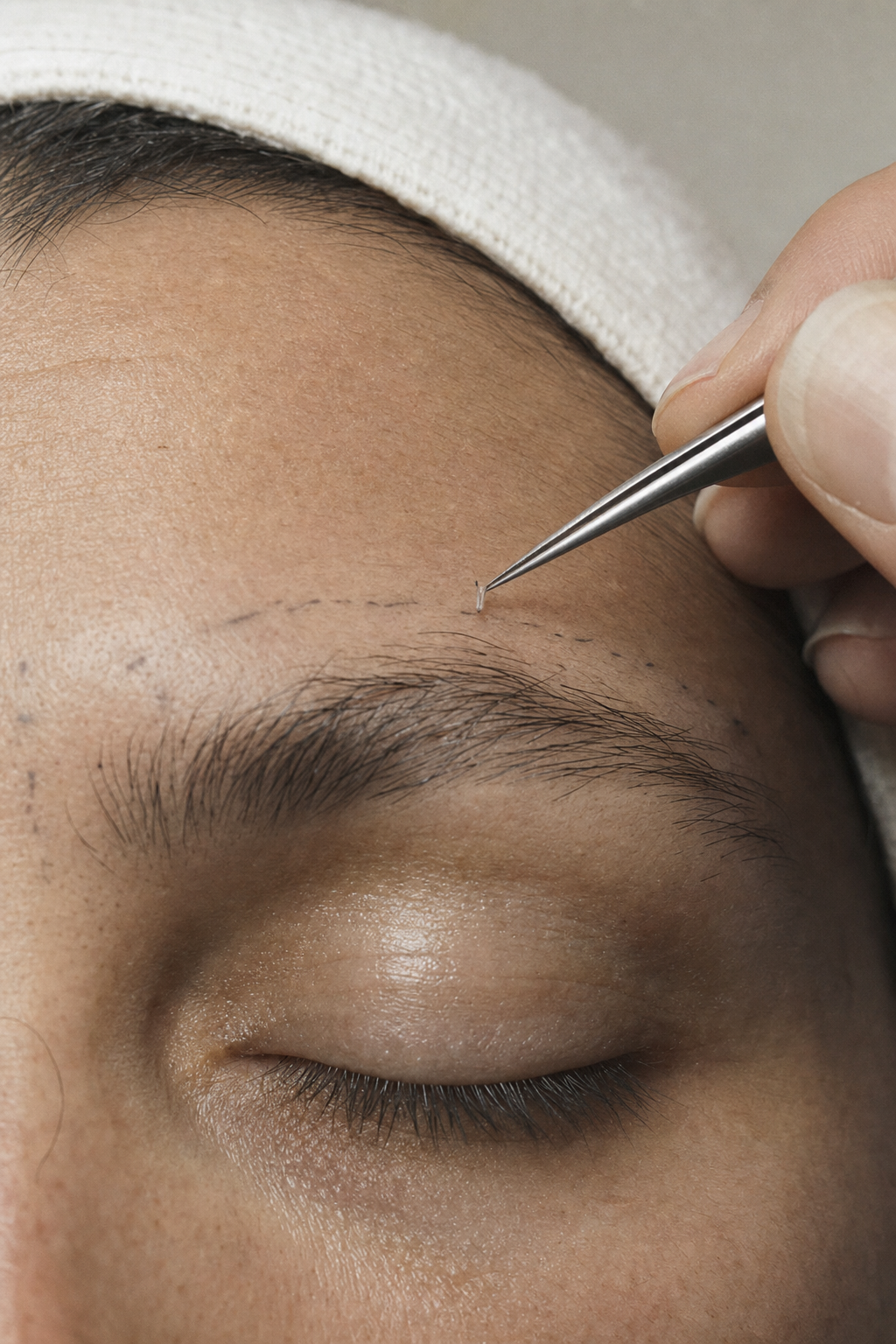
What a transplant actually does.
An eyebrow hair transplant is an FUE — follicular unit extraction — procedure. Individual follicles are harvested one at a time from a donor site on the scalp, usually behind the ear or at the nape, and re-implanted into the brow at the angle and depth a brow follicle would naturally grow. A typical brow takes 150 to 400 grafts per side, depending on coverage goal.
Because the transplanted hairs are scalp hair, they keep their scalp-hair behavior: they grow continuously, and the patient has to trim them. They also go through a shock-loss phase around weeks four to eight, when the transplanted hairs fall out before the follicles re-enter growth phase. Visible regrowth starts around month three; the final, settled result is at month twelve.
It is surgery. There is downtime, scabbing at the recipient site for the first one to two weeks, a small donor area on the scalp that heals over several weeks, and a real procedural risk profile — small, but not zero. The reward, for the right candidate, is brows that look and behave like real brows because that is, biologically, what they are.
When we recommend which.
These are the patterns we see. Edge cases exist. A consultation is the only honest way to land on a recommendation.
| Over-plucked brows from the 1990s and 2000sMost common scenario | Microblading is often the better starting point. Lower cost, no downtime, immediately visible result, no permanent commitment until you've lived with a shape for a while. Many patients spend years happy with microblading and never escalate. If they later decide they want the permanence, the transplant is still available. |
|---|---|
| Alopecia areata or scarring alopecia of the browsMedical hair loss | Depends on the disease activity. For stable, non-active alopecia where the follicles are gone, a transplant can be appropriate. For active autoimmune disease, transplant outcomes are unpredictable — the new follicles can be attacked the same way the original ones were. Alopecia tattooing at Ruth Swissa is often the more reliable answer. |
| Patients who want zero maintenanceSet-and-forget mindset | Neither option is truly maintenance-free. Microblading needs touch-ups every twelve to eighteen months. A transplant needs trimming every few weeks because scalp hair grows. The honest version: microblading is no-touch for a year-plus, then a touch-up; a transplant is daily-trim-forever in exchange for permanence. |
| Gender-affirming brow restorationSpecific goals matter | Both options work depending on goal. Patients seeking a more naturally feminine arched brow shape may prefer microblading for the precision over a single appointment. Patients restoring brow density that hair removal or hormonal treatment has thinned often prefer the transplant for the literal-hair quality. Consultation in the right studio — paramedical vs surgical — is the first step. |
| Chemotherapy-related brow lossTiming and follicle status matter | Microblading is the more common route during and immediately after treatment because it doesn't require donor hair, healing capacity, or surgical risk. For patients whose brow hair never came back fully a year or more post-treatment, a transplant can be considered. Coordination with the patient's oncology team is part of our intake. |
The honest version"Most patients start with microblading because the bar is lower in every dimension — cost, downtime, candidacy, reversibility. Some of them later escalate to a transplant. Very few patients regret starting with microblading."
Sometimes the answer is both.
It is not unusual for a patient to have a transplant on one side or in one zone — say, the head of the brow where density was thinnest — and use microblading to fill the tails and balance shape between brows in the months while the transplanted follicles are still maturing. The transplant addresses the permanent structure; the microblading addresses the immediate aesthetic and the shape.
We also see patients who have a transplant and then come in for microblading touch-ups six to twelve months after, to refine shape, soften an over-defined area, or add the appearance of finer surrounding hairs. The transplant gives the foundation; the microblading does the finishing.
These combination plans are coordinated between Swissa Med Spa and the Ruth Swissa paramedical studio, and we'll plan them with you at the cross-studio consultation rather than treating each side as a separate decision.
One conversation, two studios.
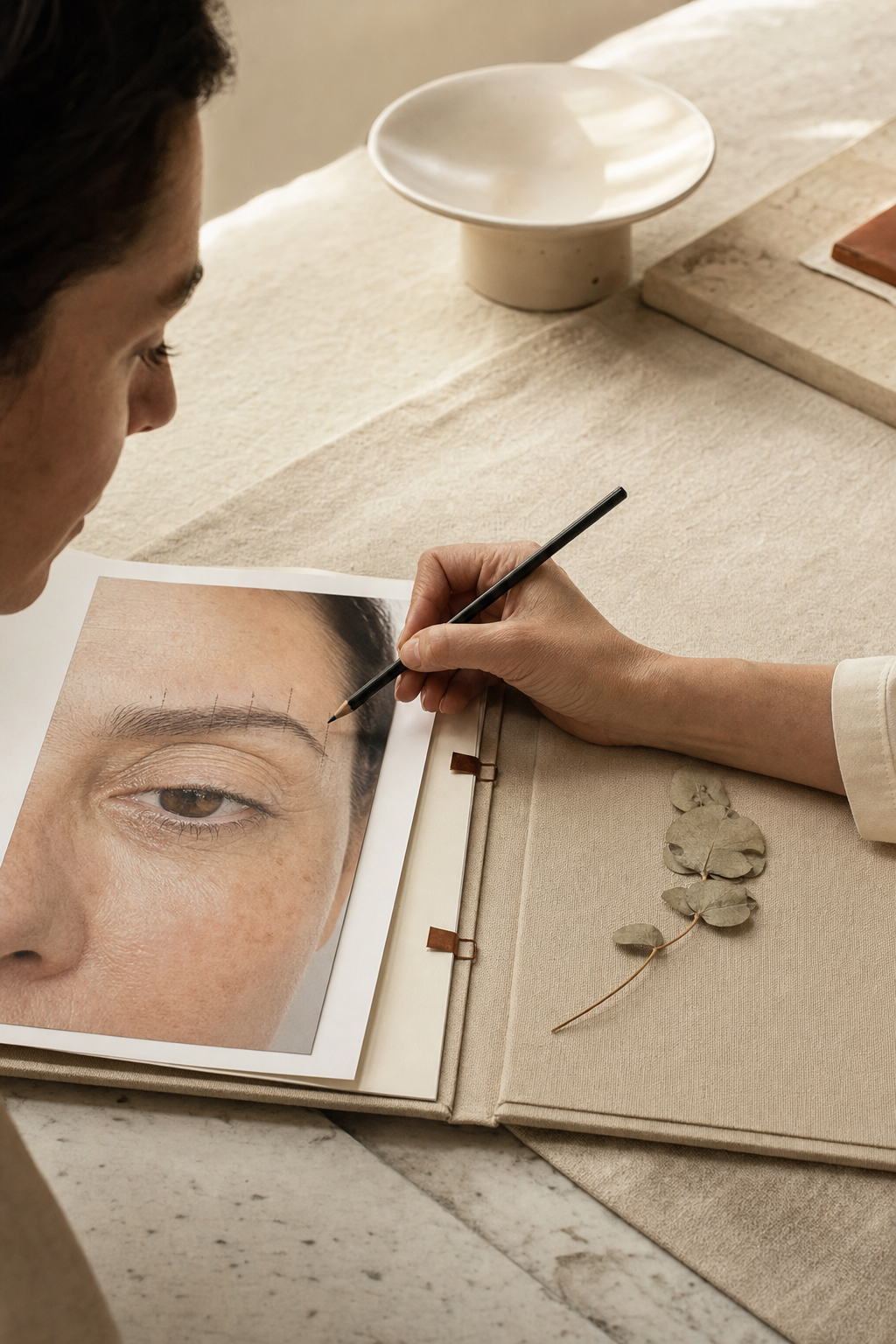
Because the decision crosses studio lines, we coordinate the consultation across both. You can start at either side. If you start at Swissa Med Spa, we evaluate transplant candidacy, donor area, target shape, and timeline. If microblading turns out to be a better fit — for cost, for reversibility, for any reason — we route you to Ruth Swissa with our notes and the shape plan we built together.
Starting at Ruth Swissa works the same direction. If, during the microblading consultation, the patient and the practitioner conclude that a transplant is the better answer for the long term, the consultation file moves with them across to Swissa Med Spa. The point is that you don't have to choose the studio before you choose the procedure — we'll choose the procedure together, and the right studio follows.
- Active autoimmune disease affecting the hair follicles — transplant outcomes are unpredictable; microblading may also flare local irritation.
- Pregnancy or active breastfeeding — no elective work, paramedical or surgical, while pregnant or nursing.
- Within twelve months of facial radiation or active dermatologic treatment of the brow area — wait until tissue has fully recovered.
- Patients within six months of isotretinoin (Accutane) — both procedures need normal healing capacity.
- Active inflammatory skin disease in the brow area — treat first, decorate second.
Questions we get.
Which one looks more natural?
An eyebrow hair transplant, on a longer timeline, because it grows real hair. Excellent microblading is undetectable from conversational distance and stands up well even up close, but it is pigment in the skin rather than three-dimensional hair. For most patients in most lighting, the difference is academic. At the twelve-month mark, a well-executed transplant has the edge for sheer realism.
How much does each one cost?
Microblading at Ruth Swissa is $600, which includes the procedure and the six-week perfecting session. An eyebrow hair transplant ranges from about $4,000 to $8,000+ depending on graft count, complexity, and the surgical team. Both are typically out-of-pocket; aesthetic restoration of this kind is rarely covered by insurance.
What if I get a transplant and don't like the shape?
This is exactly why we plan shape carefully before any procedure, and why we like the cross-studio consultation. Microblading is reversible by design — it fades, and the shape can be adjusted at each touch-up. A transplant is not. Once the follicles are placed, the shape is set, and changes are limited to trimming and possibly laser thinning of unwanted hairs.
Do I have to keep trimming a transplanted brow?
Yes. The follicles came from your scalp and they keep scalp-hair behavior — continuous growth. Most patients trim every two to four weeks. Some patients learn to like the daily ritual; others wish they had been told more emphatically before signing up. We do tell you.
Which lasts longer, microblading or a transplant?
A transplant is permanent. Microblading lasts one to three years before significant fade, and a touch-up every twelve to eighteen months keeps it consistent. If you want the brow to outlive every fashion cycle of your life without touch-ups, the transplant is the answer.
Is the transplant painful?
It's done under local anesthesia. Patients describe the procedure itself as long but not painful — the harvesting and implanting take several hours, but the work is happening on numbed tissue. Mild discomfort and tightness for two to three days post-procedure is normal and manageable with over-the-counter medication.
Can I do microblading first to test a shape, then get a transplant?
Yes, and many patients do exactly that. Microblading at Ruth Swissa is an effective way to live with a shape for a year or two before committing surgically. If after that period the shape still feels right, a transplant can place real follicles inside the same outline. The microblading fades over time and the transplanted hair takes over.
How long is the consultation, and is there a fee?
Plan for about an hour at the relevant studio. The consultation covers candidacy, expectations, photographs under standardized light, shape planning, and an itemized written plan with pricing. The consultation fee, if any, is credited toward the procedure if you proceed.
Continue.
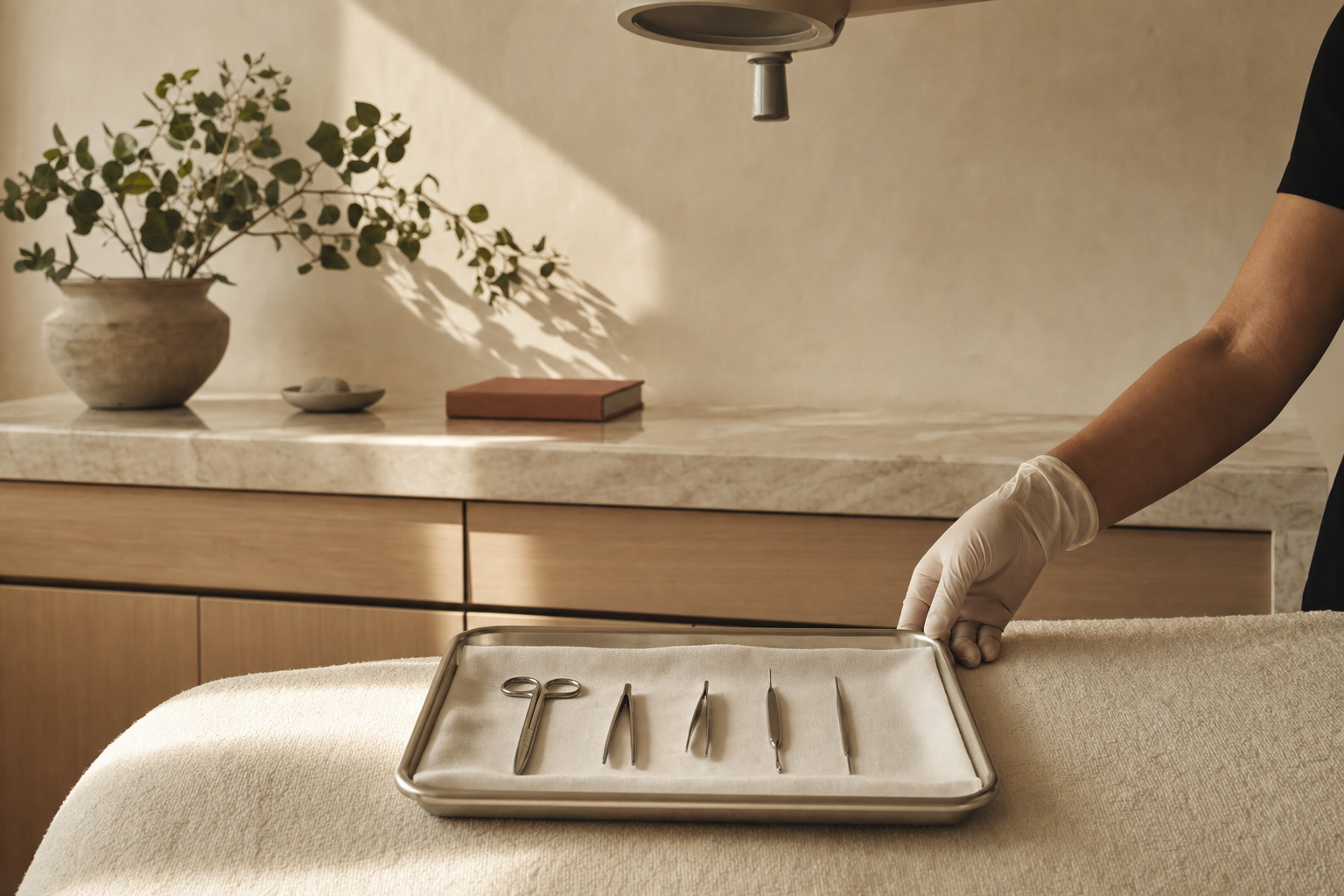
A surgical brow restoration combining Dr. Peterson's FUE training, Orr Swissa-Amran's medical execution, and Ruth Swissa's 25 years of eyebrow shape design.
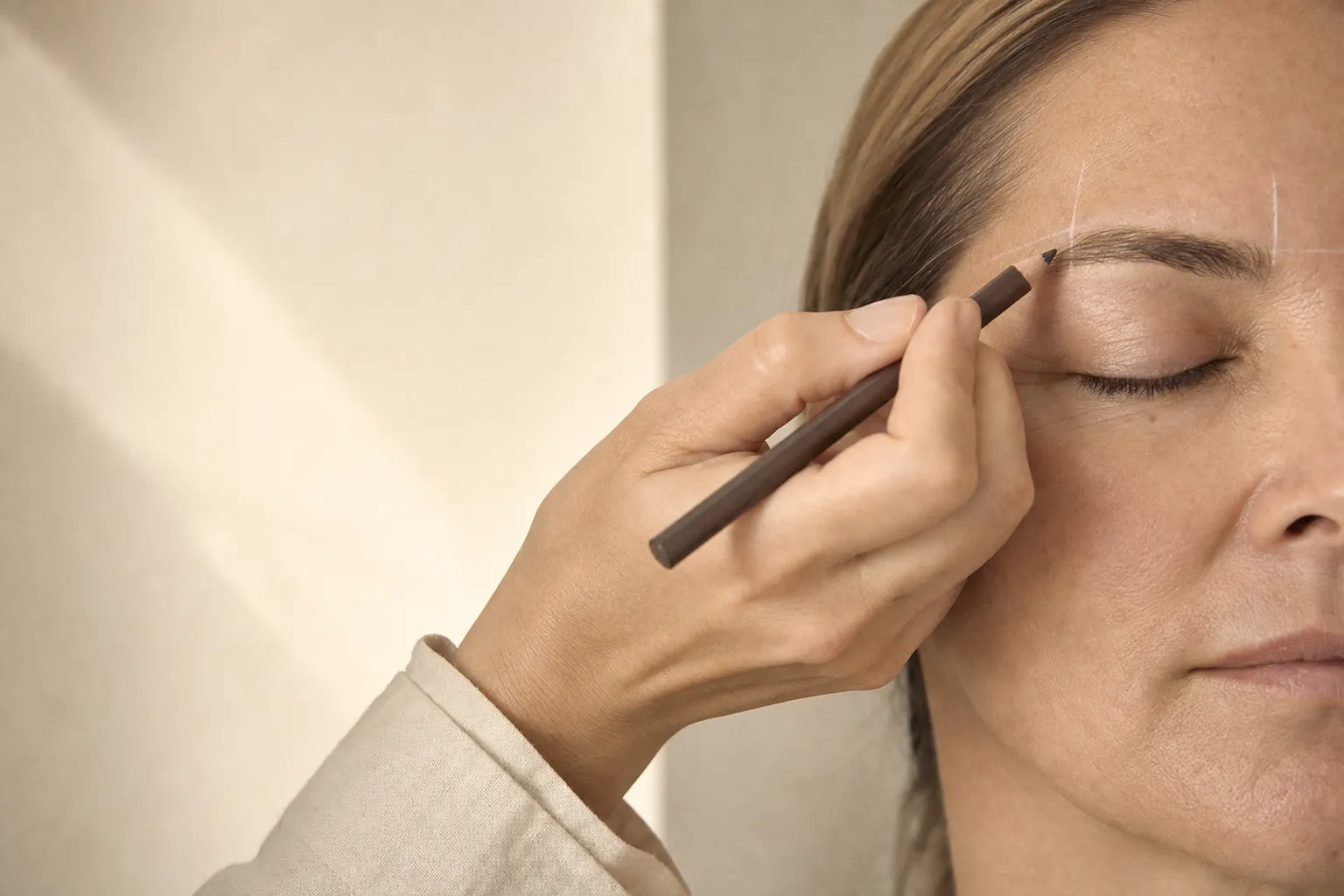
Who an eyebrow hair transplant is for, who it isn't for, and the medical and aesthetic questions we answer at the first consultation.

Treatment notes, comparison essays, and field guides.
Swissa Med Spa shares a building, a clinical team and a thirty-year history with Ruth Swissa, the paramedical tattooing practice.
Every booking starts with a conversation.
“They're truly my one-stop shop for everything beauty and skincare. The entire team is so knowledgeable, honest, and always ready to help…”